Tamahagane steel: verdict, process, and real trade-offs
What’s the short verdict on tamahagane steel?
Tamahagane steel is a cultural and craft treasure first—and a “magic performance upgrade” second. In pure cutting ability, it’s not significantly better or worse than modern carbon steels when heat treatment and geometry are done well. Where it is different is how it’s made, how it looks in the finish, and how much it asks you to actually understand the material instead of just name-dropping it.
In 2026, more cooks and collectors judge a blade by the full stack: edge geometry , hardness choices, and maintenance reality. Tamahagane steel sits right in that conversation because it forces trade-offs to be made on purpose. A clean, thin grind at 210–240 mm can feel like a laser regardless of the romance, but tamahagane adds a very specific kind of handmade “signal” inside the steel itself.
If the goal is daily line work with minimal fuss, modern steel alloys often win on convenience and predictability. If the goal is to hold history in the hand—and accept the care that comes with it—tamahagane can be deeply rewarding, in a way spreadsheets can’t measure.
What is tamahagane steel made from?
Tamahagane steel is a refined form of carbon steel made from iron sand, which is a poor source of iron. That one awkward starting point explains most of the story: the process has to work harder to separate usable steel from everything that isn’t steel, and when it’s done right the result feels “earned,” not mass-issued.
The raw material is ironsand collected from riverbeds, beaches, and hills. Traditionally, that ironsand is primarily sourced from the Okuizumo area of Shimane Prefecture in Japan. It’s a supply chain that’s physical, local, and seasonal in a way modern making steel from melted iron ore just isn’t.
Carbon content matters here because tamahagane isn’t one uniform thing. Tamahagane steel has a carbon content that typically ranges from 0.3% to 1.5%. In knife terms, that range nudges what the blade “wants to be”: tougher and more forgiving at the low end, or harder and more edge-stable at the high end—assuming the heat treatment supports it.
How is tamahagane produced in a Tatara?
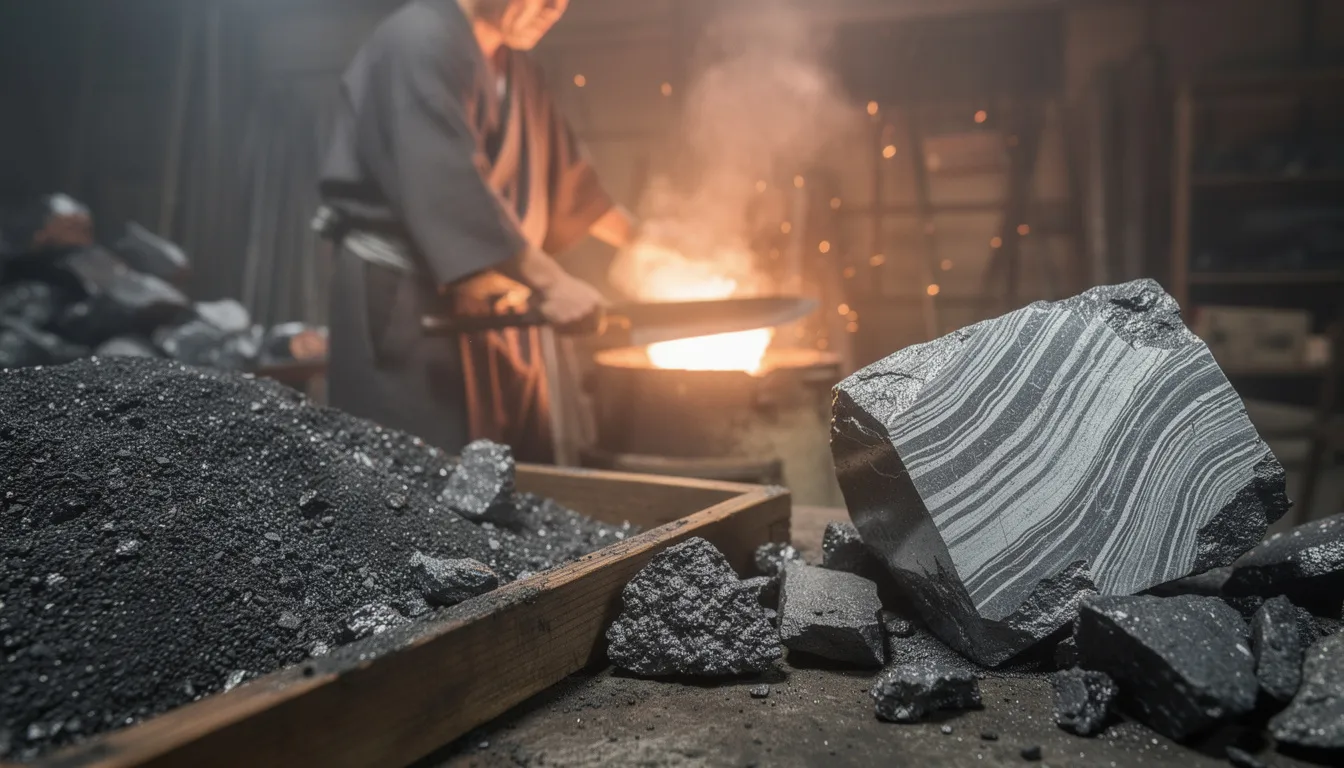
The production of tamahagane produced in practice starts with smelting iron sand and charcoal in a traditional clay furnace called a Tatara. Tatara ironmaking is a traditional method—slow, hot, and demanding—and the smelting process involves layering ironsand and charcoal, heated to about 1400℃.
Those numbers matter because 1400℃ isn’t a casual campfire heat; it’s controlled intensity over hours. The steel produced this way is reduced from ironsand at relatively low temperatures using charcoal in a clay furnace, and that shapes the inclusions and structure that end up inside the metal. It’s also why the material can feel “alive” under the hammer compared to uniform, factory-melted modern steel.
After smelting, large, irregular blocks of steel called kera are produced. To retrieve them, the collection of tamahagane involves breaking down the Tatara furnace after smelting. That destruction-and-rebuild cycle is part of why production is labor-heavy—and why the story is inseparable from the work.
Why does the steel come in different pieces?
Tamahagane contains both high-carbon and low-carbon sections which allow for differential hardening. That’s not marketing; it’s logistics and metallurgy. Even before forging, the smith is sorting material—choosing pieces for edge potential versus pieces better suited as supportive structure.
Traditionally, the quality of tamahagane can be judged by color, with the most brilliant and silvery pieces viewed as the purest. In shop terms, that “sorting moment” is where romance meets responsibility. Pick wrong, and the billet can fight back later: unpredictable hardness , weird spots that grind differently, or behavior at the edge that makes you question your stone (it’s not always the stone).
This is also where modern expectations in 2026 can clash with tradition. Most people are used to a steel name implying uniform chemistry; tamahagane asks for selection and judgment. It’s closer to cooking with whole ingredients rather than pre-measured powder—more control, more risk, more character.
What happens during folding and forging?
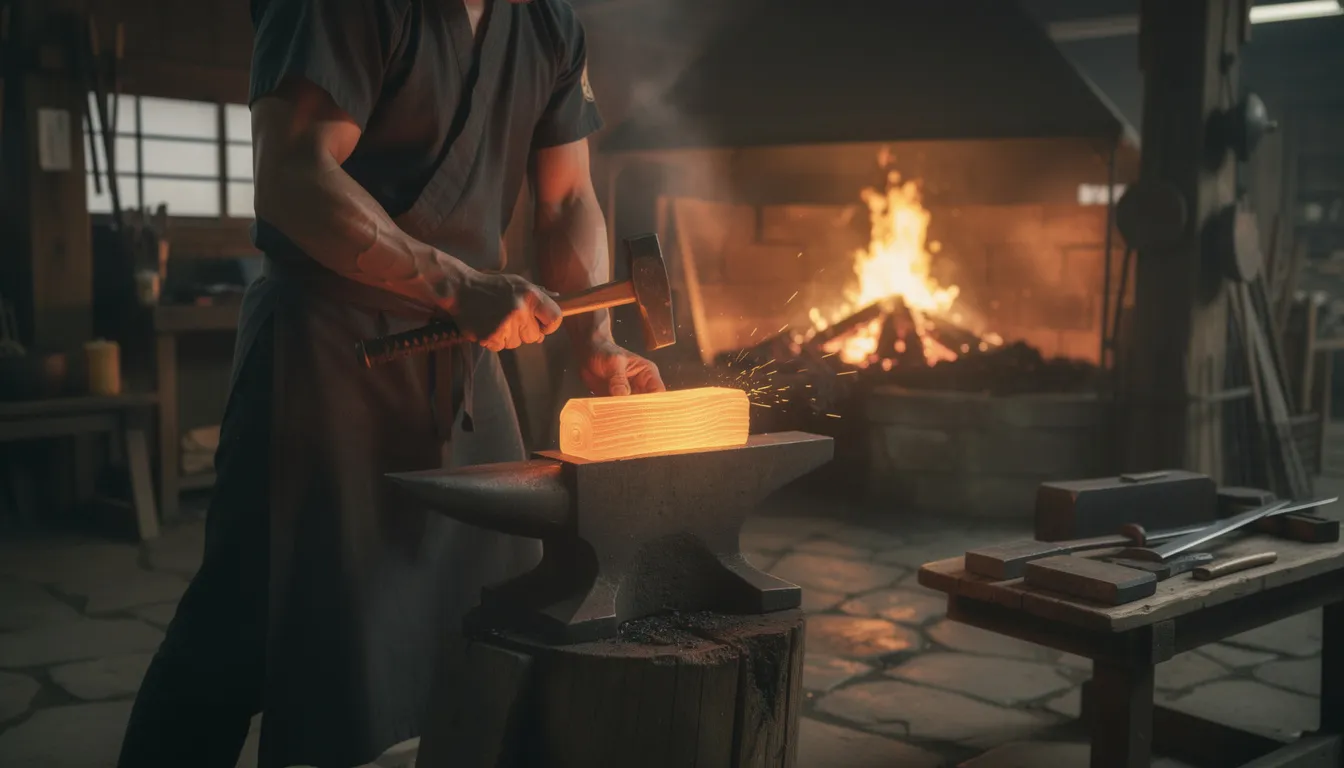
The swordsmith hammers, heats, and folds the tamahagane to remove impurities and even out carbon content. The forging process involves repeated heating and folding to create a more uniform carbon distribution. This is the part people recognize from films, but the goal is practical: reduce variability , manage inclusions, and stack the odds in favor of a clean-working blade.
The folding process used in tamahagane refining creates a visible grain called hada. That grain is not “proof it’s sharp”; it’s proof of the pathway the material took. In a knife shop, it’s like reading end grain in wood—direction, layers, and history show up once the finish is right.
There’s a real trade-off here. The toughness of tamahagane steel can be affected by oxide inclusions, which may limit ductility. So the smith is balancing refinement with not overworking the steel into something brittle, cranky, or unpredictable.

How do hamon and microstructure actually form?
The final step in the swordsmith's process is quenching, which hardens the blade by rapid cooling. In tamahagane work, this is where heat, time, and geometry collide. Hamon refers to the temper lines formed in tamahagane blades during quenching, and those lines are literally a transformation map you can see—with the right polish.
On the microscopic level, the microstructure of tamahagane steel typically includes a combination of martensite and pearlite, contributing to hardness and toughness. Speaking plainly: martensite is the hard “bite,” pearlite is part of the “don’t snap on impact” side of the equation. The aesthetic features—grain patterns and temper lines—raise the artistic value, but they’re also tied to real metallurgical events, not wishful thinking.
For historical context, the hardness of the cutting edge of Japanese swords made from tamahagane typically ranges from 600–900 HV. That number helps explain why people connect tamahagane with serious edge potential, even though a kitchen knife doesn’t need to chase sword-like extremes to be great. In kitchen knives, edge stability plus sane thinness often beats “maximum hardness” as a lifestyle choice.
Is tamahagane better than modern steel?
Tamahagane steel is not significantly better or worse in performance compared to modern carbon steels. That line can disappoint anyone hoping for a clean ranking, but it’s the honest baseline. Steel matters, yet geometry and heat treatment often matter more once a decent floor is met.
Modern steel is engineered for consistency: predictable chemistry, predictable hardening, repeatable results. Traditional japanese steel like tamahagane is “engineered” through a process of selection and repeated refinement rather than lab-controlled melts. The difference shows up less in “can it get sharp” and more in skill and labor it take to make it behave.
Both tamahagane and carbon steel can be honed to a keen edge for the high demands of swords. In a kitchen, that translates to clean push-cuts through onions, crisp herb work, and controlled protein slicing—assuming the edge is set well (often ~12–15° per side on double bevels, steeper on single bevels when appropriate). The trick is matching the steel’s personality to the knife’s job, not just its vibe.
How does tamahagane change knife use and geometry?
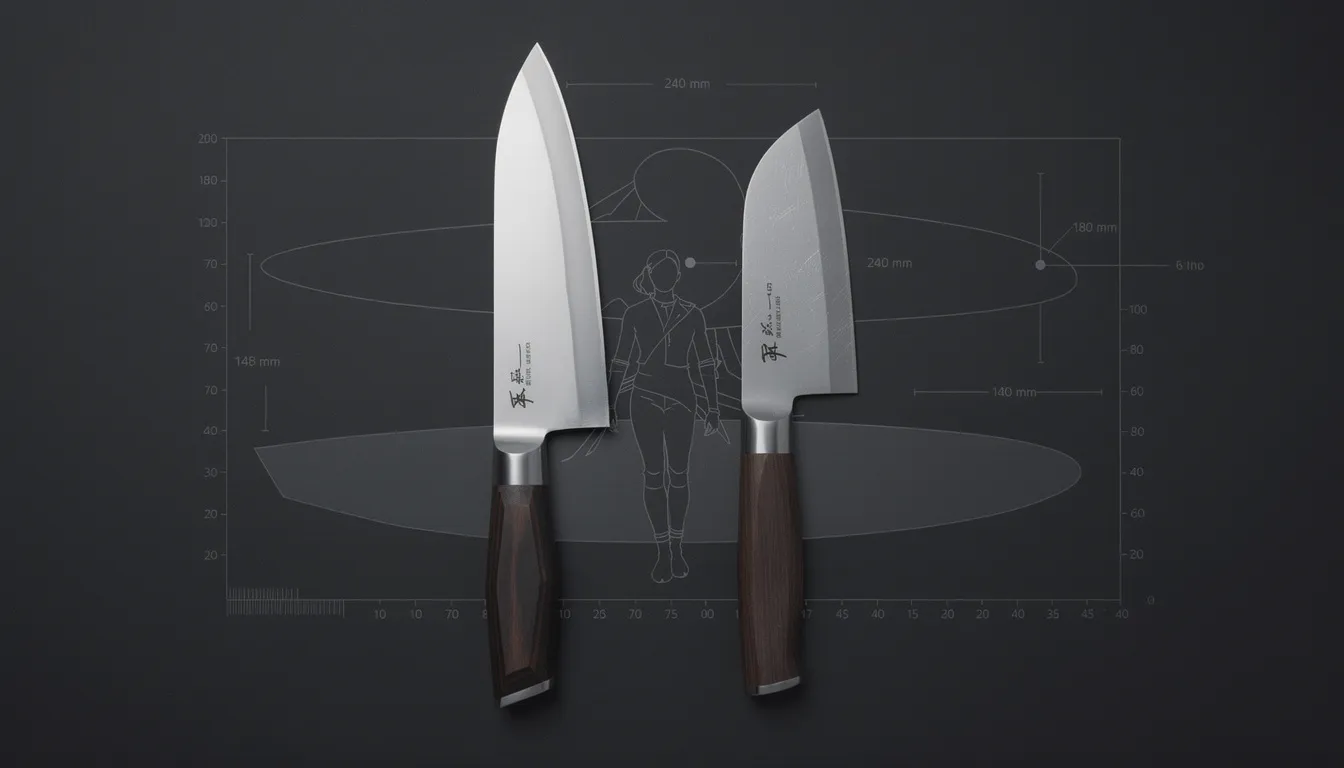
Steel doesn’t cut food alone; geometry does. A 240 mm gyuto with a thin tip and steady distal taper behaves differently than a 180 mm bunka with a taller heel and a flatter spot for chopping. Tamahagane can support extremely sharp edges, but it also punishes sloppy geometry if inclusions or uneven carbon are still present, because weak spots don’t care about your Instagram lighting.
In practice, thin behind-the-edge geometry rewards careful technique. For a general-use gyuto (210/240 mm), a moderate spine thickness near the handle and a thinner mid-blade can give stability without feeling clubby. For delicate work, a petty (120–150 mm) can go thinner, but it’s still safer to keep the edge supported if the steel’s internal grain is variable than factory steel.
Here’s a shop-style rule that holds up:
Single bevel (yanagiba, deba, sakimaru): rewards controlled cuts and careful sharpening angles.
Double bevel (gyuto, bunka, kiritsuke-style double bevel, western style chef knife): more forgiving and easier for mixed prep.
A brief micro-case from the forge bench: when dialing a kiritsuke-style double bevel, it’s tempting to make the tip ultra-thin for that “paper glide.” With tamahagane steel, that can be amazing—until a board contact at the wrong angle finds a weak spot in structure. Leaving just a touch more meat behind the edge often makes the knife more honest in daily service, which is a very unromantic way to protect romance.
Why do laminated builds matter with traditional steel?
Laminated construction in katanas typically involves a hard, high carbon outer layer and a soft, low-carbon inner core. That concept carries over beautifully into kitchen knives, even if the exact layouts differ. The composition of tamahagane allows smiths to craft blades with a hard edge and a tough core, which is basically the dream for cutting performance plus durability.
This is also where bloomery steel thinking enters the kitchen discussion. Tamahagane behaves like a carefully refined bloomery steel: it can be excellent, but it asks for construction choices that support it. Pairing a hard edge steel with a tougher core helps manage shock and reduces the chance that a very hard edge fails catastrophically.
In MG Forge work, the philosophy is similar whether the billet began as traditional material or modern stock: build the knife so the edge does the work, and the rest of the blade protects that edge. That usually means sensible thickness transitions and a heat treatment that doesn’t chase numbers at the expense of real kitchen reliability.
What about finishes like wrought iron and damascus?
Once performance is handled, finishes become the language of the blade. A wrought iron cladding can show fibrous texture after etching and polished work, and it pairs naturally with the grain story of traditional material. Pattern-welded damascus (including forge-welded damascus and what people casually call “damascus steel”) can add contrast, but it’s worth remembering the pattern is not automatically a performance feature—pretty doesn’t get to skip physics.
The aesthetic qualities of blades forged from tamahagane, including their unique patterns, make them symbols of craftsmanship and heritage. That’s especially true when hada and subtle activity show through a thoughtful finish. The goal is to reveal what the steel is doing, not to bury it under aggressive texture.
For kitchen practicality in 2026, many buyers want a finish that’s honest to maintain:
Kasumi-style: easy to refresh, soft contrast, great for laminated looks.
Fine satin: straightforward cleanup, more “tool-like.”
Mirror polish: stunning, but scratches show quickly in real prep.
How much maintenance does tamahagane need?
Tamahagane steel tends to require more maintenance to prevent rust compared to modern carbon steel alloys. It’s still carbon steel behavior at heart: moisture, acids, and time are the enemies. In practice, that means wiping during prep, especially with citrus, tomatoes, and onions, because the blade doesn’t care that you were “just going to finish one more thing.”
Patina is part of the deal. A stable patina can slow active rust, but it’s not permission to leave the knife wet. For storage, dry the blade, avoid leather sheaths for long periods, and don’t store it touching other utensils—small edge hits add up fast on high hardness edges. Sharpening is also where maintenance becomes enjoyable: a well-forged blade often gives clear feedback on stones, and a simple progression can be enough for kitchen sharpness.
A quick kitchen routine that keeps things sane:
Rinse and wipe immediately after acidic ingredients.
Dry fully before putting the knife away.
Touch up lightly rather than waiting for the edge to feel “dead.”
Why is tamahagane tied to swords and culture?
Tamahagane steel is historically significant as it is the material used to create samurai swords in Japan. Tamahagane steel dates back to the 6th Century AD in Japan, and the term tamahagane means “jeweled steel” or precious steel in Japanese. That’s not just poetry; it reflects how rare and valued the material has been in japanese culture.
The production of tamahagane steel is protected as an important intangible cultural property in Japan. It has also been recognized by the Minister of Education in Japan as a traditional craft designated for preservation. The traditional craft of sword making with tamahagane steel is passed down from generation to generation in Japan, which makes the material inseparable from the human chain that keeps it alive.
That connection to japanese swords, samurai swords, forging swords, and sword making is why the steel carries weight even outside the sword world. In a kitchen knife, the “why” shifts from battlefield durability to food control—but the discipline stays the same: precise forging, controlled heat, careful quench behavior, and respect for maintenance. As MG Forge would put it quietly: the knife still has to work on a board.
For a primary source on Japanese sword terminology and metallurgy context, the NBTHK (Nihon Bijutsu Token Hozon Kyokai) is a solid starting point: https://www.nbthk-ab.org/
What is special about tamahagane steel?
Tamahagane steel is special because it’s traditional japanese steel made from ironsand (iron sand) in a Tatara process, producing kera that must be sorted and refined. Its folding can create visible hada, and quenching can produce a hamon, tying beauty to real heat-treatment events rather than marketing fog. It’s also culturally significant as the historic steel of japanese swords and samurai swords.
What steel is better than tamahagane?
No single steel is simply “better,” because tamahagane steel is not significantly better or worse in performance compared to modern carbon steels. Modern steel often wins on consistency, easier maintenance, and predictable carbon content and other elements, while tamahagane can win on heritage, process-driven character, and distinctive aesthetics. For kitchen knives, geometry and heat treatment usually decide more than the word on the invoice.
Why is tamahagane so expensive?
Tamahagane steel is much rarer and significantly more expensive due to its labor-intensive production process. It involves Tatara smelting with charcoal and ironsand in a traditional furnace (a clay furnace), then breaking down the furnace to retrieve the kera and refining it through repeated forging and folding. Mass production is difficult, output is limited, and a significant amount of labor goes into sorting pieces by quality—so cost follows time, skill, and scarcity.
How rare is tamahagane steel?
Tamahagane is considered a rare and precious material due to its labor-intensive production process, and it’s made only a few times a year to ensure quality. The raw material is ironsand from specific regions in Japan, and the method is protected for preservation, which limits scale compared to modern steel production from iron ore and ore blends. Practically, that rarity shows up as limited availability , higher prices, and fewer makers willing to deal with the extra variables—carbon content swings, slag risks, and other constituents that must be managed during the forging process.
How do raw materials and impurities shape tamahagane’s consistency and cost?
As traditional japanese steel, tamahagane begins from iron ore-like inputs via ironsand rather than uniform melts, so even a small amount of variability in carbon and other elements can shift results, especially when other constituents and slag must be managed through sorting and forging; compared with modern tools built from consistent ore-derived metal, this process can yield better quality in the hands of a skilled smith or lower quality when selection and refinement go wrong, and the Tatara setup (clay tub) and furnace cycle leaves parts of the build literally broken and rebuilt, which is why most people see the material as precious in the world of knives and swords—yet performance still depends on geometry, heat treatment, and how the edge is sharpened, with laminated thinking (core) often used to support durability and keep the romance from becoming just a word, even when a traditional shop like MG Forge treats the process as significant rather than mystical (oven; present).