Kiritsuke knife: what it is and how to use it
What is a kiritsuke knife, really?
A kiritsuke knife is a hybrid design that borrows the reach and slicing feel of a yanagi (yanagiba) and the day-to-day utility of a gyuto. In practice, the kiritsuke knife is built for push cutting, clean slicing, and precise prep that rewards calm hands over chaotic energy. It’s famous for versatility, but it also asks for more attention than many general-purpose knives.
There’s a second “family tree” worth noting. Plenty of descriptions frame kiritsuke as blending yanagi and usuba traits, which makes sense the moment that flat edge meets vegetables. Either way, the identity stays the same: a long, controlled cutter with a k tip and a sharp point for detail work—basically the opposite of “whatever, it’ll do.”
In 2026, more cooks want one tool that does “most” without feeling like a generic chef’s knife clone. A kiritsuke knife fits that trend, but only when the geometry matches the cutting style. Get that wrong, and it can feel like a beautiful piece of steel that politely refuses to cooperate.
Why has kiritsuke been a status blade?
Traditionally, the kiritsuke knife was considered a master chef's knife in japanese cuisine, reserved for executive chefs or head chefs. It functioned as a symbol of expertise and status—and also as a quiet sign that the user could actually handle it. Single bevel knives in this pattern, in particular, demand skill and consistent technique from a master chef, not just confidence.
That tradition isn’t only ceremony. The kiritsuke’s layout creates real compromises that take experience to work around, especially when switching between slicing fish and vegetable prep. A “do-a-lot” tool can also be unforgiving when angle or pressure drifts, and kiritsuke tends to remember your mistakes.
From the forge side, this status idea still shows up in modern requests. At MG Forge, the most common kiritsuke conversations start with: “I love the look—will it behave like my chef's knife?” The honest answer is: sometimes yes, sometimes no, depending on bevel choice and profile.
What makes the k-tip and flat edge special?
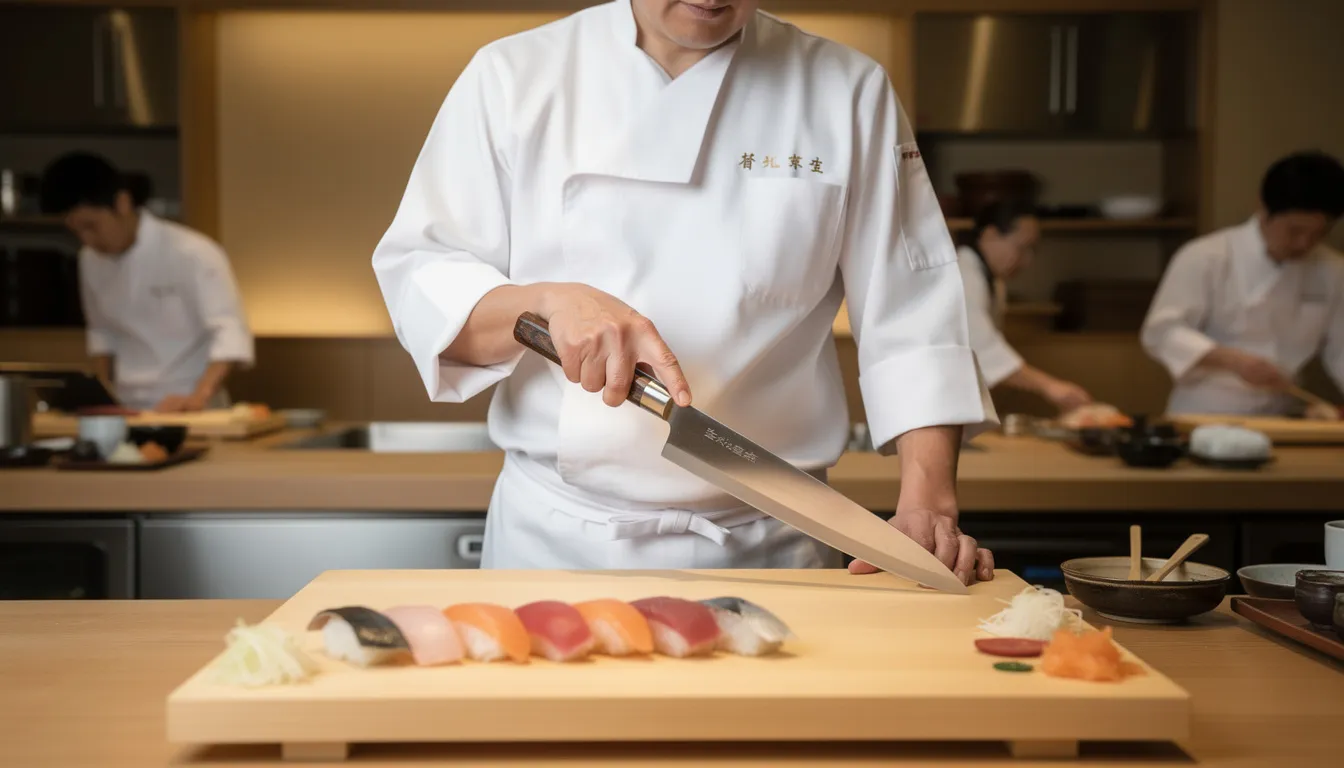
The distinctive angled tip—often called a k tip—also known as a reverse tanto tip, gives extra control for detailed work compared to many chef's knife profiles. It’s great for scoring fish skin, trimming silver skin, or tight dicing where the last 25–40 mm of the edge matters most. The pointed tip feels like a small blade mounted on a long blade, which is exactly why it’s both useful and easy to overdo.
Just as important: a kiritsuke’s flatter edge is built for linear movement rather than rocking. Push cutting is the natural rhythm here—heel on the board, then forward and down in a straight line. If someone is used to a curved Western chef's knife and constant rocking, the kiritsuke can feel stiff, like it’s silently judging your technique.
Thickness and blade height shape the feel, too. A taller, stiffer kiritsuke can feel stable in push cuts, yet more challenging in long slicing motions if food sticks or the blade isn’t thinned well behind the edge. That’s where grind quality matters more than flashy finishes or surface patterns.
How long should the blade be?
Kiritsuke knives are typically found in a blade length range of 240 mm to 330 mm. That length span is a big part of why they’re versatile for slicing fish, cutting vegetables, and dicing meat. A 240 mm kiritsuke tends to suit mixed home prep, while 270–300 mm starts to feel more “pro line” on big boards, especially for executive chefs working fast but clean.
Blade length changes more than reach—it changes leverage and control. Past 270 mm, the tip can feel farther away, so small errors at the handle show up at the point. On the other hand, a long blade will glide through proteins with fewer start-stop marks, which matters when you care about clean surfaces and neat slicing.
In kitchen terms, a kiritsuke can cover a surprising spread: vegetable knife duties like cabbage, cucumber, and onion; clean slicing sashimi when the edge is truly polished; and neat portioning of boneless proteins. For heavy work—bones, shells, hard joints—a deba still belongs on the board instead, no matter how confident the cutting feels.
One extra note: some kiritsuke patterns can be unwieldy for katsuramuki-style peeling. That’s not a moral failure, just physics: long, flat edge geometry plus certain blade height choices can make that rotating ribbon cut awkward.

Single bevel or double bevel?
Here’s the fork in the road. The single bevel kiritsuke requires considerable skill because the edge geometry behaves differently in the cut. Food release, steering, and sharpening are all more technique-dependent than most people expect, which is why single bevel knives can feel “alive” and annoying in the same session.
A double bevel kiritsuke is the bridge for modern kitchens. The double bevel edged kiritsuke can handle many tasks normally done with a gyuto, with less drama and easier maintenance. Double bevel kiritsuke knives also offer greater ease of use for home cooks and many working chefs, while still keeping that kiritsuke attitude.
The main difference comes down to edge geometry: single bevel is specialized and directional, while double bevel is more symmetrical and forgiving. In the shop, this shows up during final sharpening—single bevel work is about controlling a wide bevel surface, while double bevel work is about balancing two smaller bevels cleanly and consistently.
How does forging and steel choice affect performance?
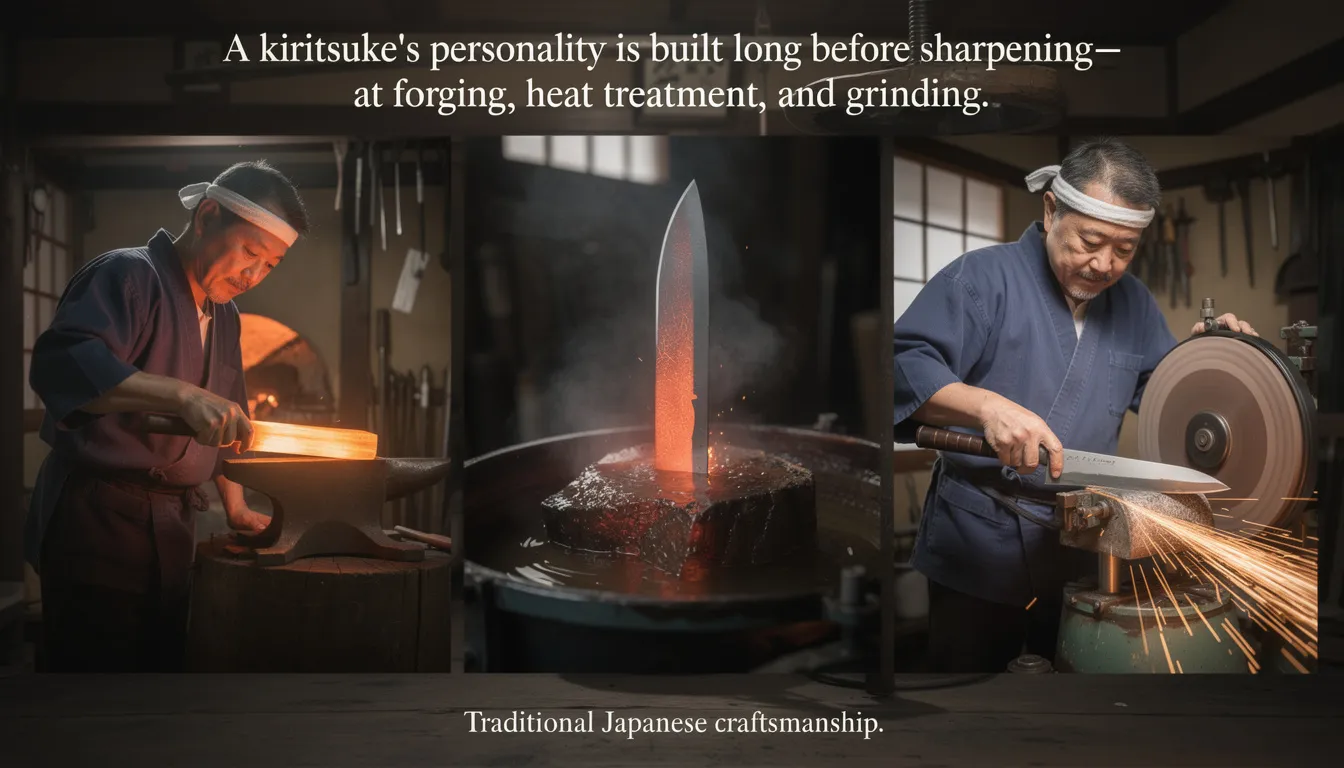
A kiritsuke’s personality is built long before sharpening—at forging, heat treatment, and grinding. Traditional Japanese work often pairs a hard cutting core with softer cladding for support and easier maintenance behavior. That’s why materials like fibrous iron show up in classic constructions, bringing toughness and a feel many collectors describe as “alive” on the stones.
Tamahagane and forge-welded damascus (pattern-welded stacks) can be part of that story, but pattern alone doesn’t guarantee performance. What matters is how the blade is heat treated and then ground to the right geometry for push cuts and pull cuts. A kiritsuke that’s thick behind the edge will wedge in dense vegetables, no matter how pretty the finish looks in reviews.
A quick workshop micro-case: a recent kiritsuke request came from a cook who does a lot of slicing fish, but also wants a daily prep knife. The solution wasn’t “harder steel” or “more layers”—it was choosing a profile that keeps the front half nimble and setting the grind so the flat edge tracks straight without stiction, something MG Forge ends up discussing more often than people expect.
What technique and care keep it honest?
Kiritsuke knives reward cutting techniques that differ from curved Western chef knives. For control, a pinch grip is usually the safest baseline, especially with a reverse tanto / k tip that can bite if the wrist gets lazy. For delicate fish or meat, pull-cutting works beautifully—let the edge draw through in one calm motion instead of sawing.
Push cutting is the other core move: place the heel against the food and push forward and down. That straight path matches the flat edge design and keeps the tip from digging into the board. Trying to rock-chop tends to twist the edge in ways it doesn’t like, and the kiritsuke will respond by getting less polite.
Sharpening is where ownership becomes real. A whetstone is the best choice for maintaining a kiritsuke, especially traditional single-bevel models, because stones let you control angle and contact. Hard cutting surfaces are the fastest way to chip or dull a fine edge, so wood or quality synthetic boards beat glass, granite, or bamboo that’s overly dense.
If a deeper metallurgy rabbit hole is needed, the American Bladesmith Society has solid foundational material on heat treatment concepts and edge behavior: https://www.americanbladesmith.org
What is a kiritsuke knife used for?
It’s used for precision prep across fish , vegetables, and boneless meats—especially slicing raw fish, slicing sashimi, and clean push cutting through produce. The k tip (reverse tanto) helps with fine tasks like scoring fish skin or tight dicing, where control at the tip matters. Many cooks treat it as a multi purpose knife for “most sessions,” as long as heavy butchery is kept for a deba or a sturdier blade.
Why is a kiritsuke knife difficult to use?
The flat edge favors linear cutting, so rocking like a Western chef's knife can feel awkward and can lead to mistakes. Single bevel kiritsuke models are harder still because the edge geometry can steer in the cut and demands consistent angle control. Longer blade length choices (often 240–330 mm) also magnify small hand errors at the tip, especially when you’re moving fast.
What is the difference between a kiritsuke knife and a Santoku knife?
A kiritsuke is typically longer (often starting around 240 mm) and built around push cutting and slicing with a flatter edge and a k tip. A santoku is usually shorter and more compact, aimed at general home prep with an easier, friendlier profile. In short: kiritsuke feels closer to a specialized slicing knife / chef's knife hybrid, while santoku feels like an everyday chef's knife alternative.
Is kiritsuke all purpose?
It can cover a lot, especially in a double bevel version that behaves closer to a gyuto or kiritsuke gyuto. Still, it’s not truly all purpose if the job includes bones, hard shells, or rough board contact—those tasks risk edge damage and make even great knives miserable. Think of it as broadly versatile for precision work, not a beater knife that you can treat like a nakiri, bunka, and deba all at once.
How do kiritsuke features shape technique, versatility, and control?
A kiritsuke is defined by its blade geometry and tip design: the k-tip behaves almost like a small sword point for delicate, precision work on fish and sashimi, while the flat heel and limited belly discourage rocking chopping and instead favor straight, controlled slices through vegetables and clean portioning of meat; these features help explain the versatility that chefs admire in reviews, yet also why it was traditionally considered a master tool and a symbol of status, a sign of calm technique and a handle that can keep the long profile steady, especially as length grows and the knife becomes more specialized compared to a gyuto or a bunka, with a taller feel that can affect how food release and steering perform; it is typically easy to adapt to in double bevel form for everyday tasks, but single bevel choices reduce ease and demand more consistency, so shops like MG Forge often check use-cases to keep the front nimble and the grind thin behind the edge; for practical buying, stock availability may shape what is close to ideal, and some makers streamline cart and order steps while still emphasizing that careful making matters more than looks