Japanese petty knife: what it is and what it’s for
What makes a japanese petty knife so useful?
A japanese petty knife is the small blade that somehow ends up doing the most. It lives between paring knives and a chef’s knife, solving that awkward gap where a tiny knife feels cramped and larger knives feel like overkill. In real prep, a japanese petty knife becomes the “grab it first” tool for detailed work, quick slicing, and all the little cutting tasks that keep a kitchen moving.
Most people feel the difference in the first minute: petty knives tend to be light, well-balanced, and fast in the hand. That lighter feel can reduce hand and wrist strain during repetitive precision tasks like trimming and peeling. And in 2026, with line cooks and home cooks alike paying more attention to fatigue and workflow, that matters as much as raw sharp.
A petty knife also delivers a very specific kind of control. The compact size and low inertia make it easy to stop exactly where you want, which is why it’s a favorite for delicate tasks. This is the knife that makes prep feel clean instead of clumsy, especially when you’re chasing precise cutting rather than brute force.
Where does “petty” come from?
The name “petty” comes from a French word petit, meaning “small.” It’s an accurate label: a small preparation knife built to handle the little stuff without switching knives every two minutes. The term stuck in Japan’s kitchen culture, even though the knife itself is now closely tied to Japanese geometry and steel preferences.
“Small” also doesn’t mean “limited.” The petty often preps ingredients so a larger knife—like a gyuto or sujihiki—can take over for long slicing. So it’s not trying to replace a chef’s knife; it’s the essential complement that makes the rest of your kitchen knives feel quicker.
How is it different from a paring knife and a gyuto?
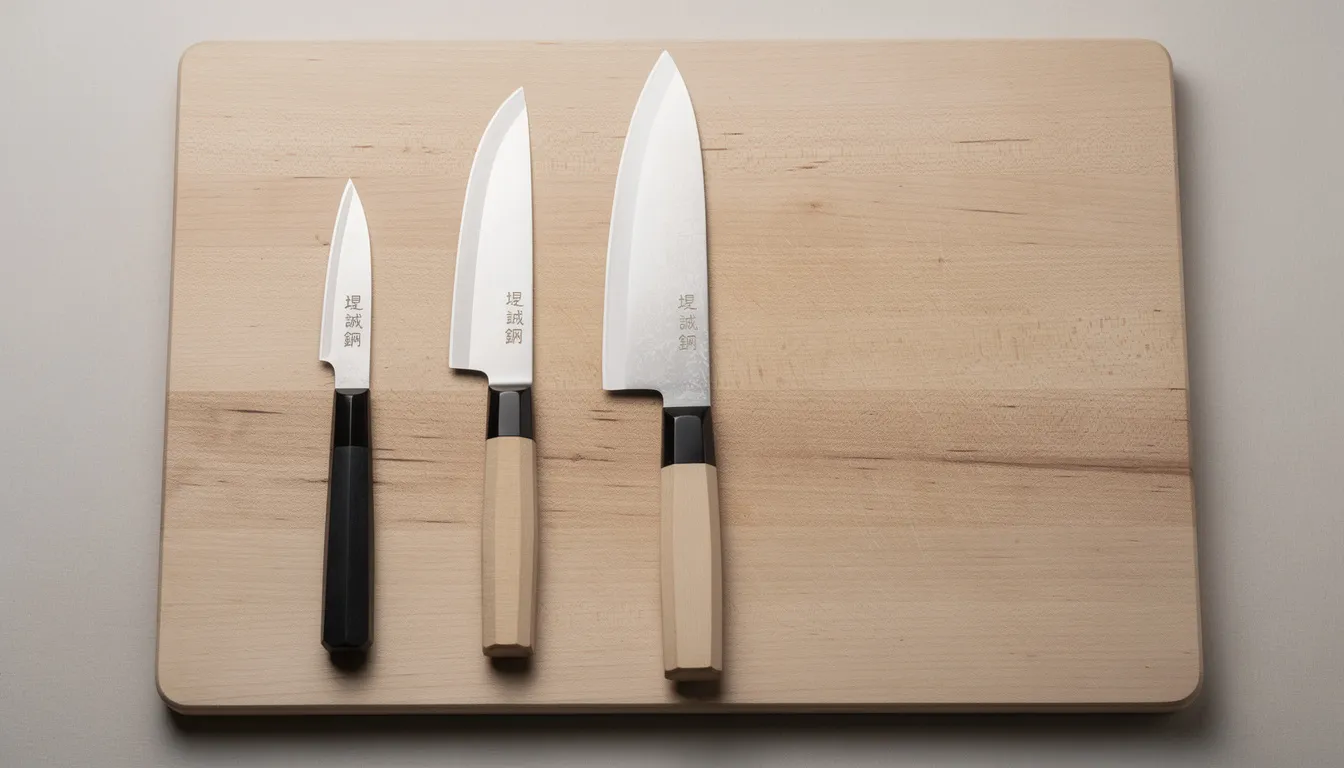
Size is the obvious divider. The Japanese petty knife is bigger than paring knives and smaller than a gyuto, which puts it right between in-hand work and board work. That middle spot is exactly why it’s useful: it can do both styles without feeling “wrong” in either.
Typical ranges get described two ways, and both exist in the wild. Many petty knives land around 120–165 mm (about 4.7–6.5 in.), while another common spec range is 90–150 mm (3.5–5.9 in.) for more compact builds. The overlap is normal—makers label petty differently depending on profile, grind, and intended tasks.
On the board, a 150 mm petty can handle small vegetables and mincing garlic without the heel smashing into your knuckles. In the hand, a 120 mm model feels stable for peeling or coring. The win is the same either way: useful blade lengths that don’t fight you.
What kitchen jobs does a petty actually handle?
The petty knife shines in the stuff cooks repeat all day: peeling, coring, hulling strawberries, and slicing small produce like tomatoes, shallots, and garlic. It’s also common for peeling apples and potatoes, where agility beats reach. For trimming silver skin or cleaning up chicken joints, it has enough blade to work cleanly without the bulk of a chef’s knife.
This is where the petty’s “detail” personality shows up. It’s great for fine slicing, garnishes, herbs, and small, clean cuts where a wide gyuto face can feel like steering a shovel. That maneuverable feel makes it ideal for detailed work and other precision tasks that are simply too awkward for larger knives.
A practical kitchen split looks like this:
Petty (120–150 mm): detail prep, trimming, small fruit/veg, quick line work
Gyuto (210–240 mm): most board work, proteins, larger produce
Yanagiba / sakimaru: long draw cuts for fish and sashimi
Deba: heavier fish butchery and tougher breakdown tasks

What blade shapes matter most?
When people talk petty knives, they often fixate on length and skip geometry. But blade shape is what makes a knife feel “precise” instead of merely “small.” Many Japanese petty profiles lean toward a straighter edge with a triangular silhouette, which supports neat up-and-down cuts and cleaner detail work.
That shape also changes how the tip behaves. A finer tip helps you “place” cuts—removing eyes from potatoes, trimming strawberry stems, or doing tight trimming around produce. But very thin tips punish bad habits, and twisting the blade in a dense carrot is how you learn that lesson.
In the forge, it’s a quiet trade-off. A little more meat behind the tip can save a knife in professional kitchens, but it changes how effortlessly it glides through tomato skin. The best petty profiles aim for strength without losing that crisp point control.
Double bevel or single bevel—what’s common?
Most modern petty knives are double-bevel, meaning sharpened on both sides. That makes them ambidextrous and easier to maintain. Some petty knives use asymmetrical grinds tuned for right-handed users, which can help food release and steering, but it also means sharpening needs a bit more attention.
Single bevel usually belongs to specialized Japanese knives like yanagiba or deba. A petty is expected to bounce between cutting tasks, and a double bevel supports that versatile role better. A common sharpening target for a double-bevel petty is roughly 12–15° per side, adjusted based on hardness and how thin the edge is ground.
Asymmetry isn’t “better” by default. It can feel amazing in one hand and weird in another, and different boards and ingredient styles can change the feel. That’s why many makers keep petty knives neutral and predictable.
How do japanese knives differ from western style knives here?
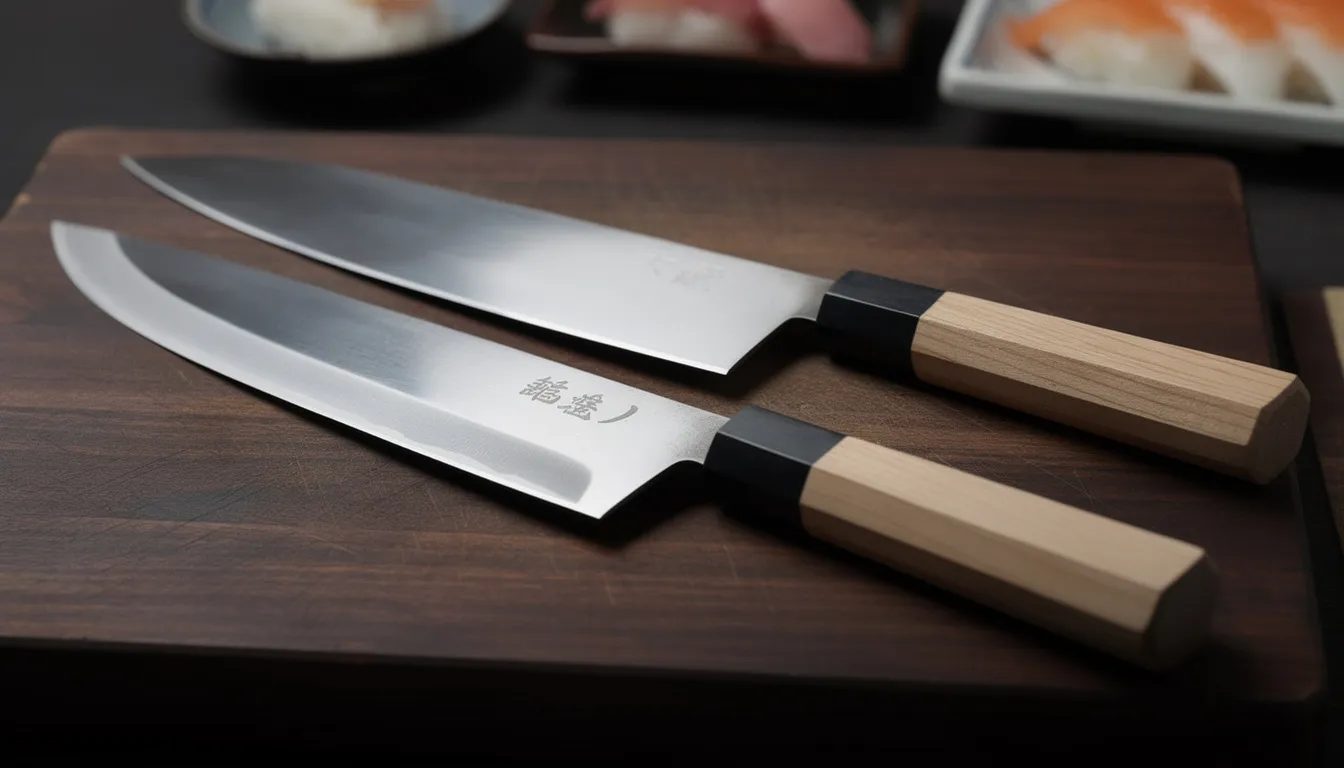
The steel-and-hardness story is the big divider. Japanese petty knives often run thinner and harder—commonly HRC 58–64+—than many western style knives. That hardness supports very fine edges for trimming, garnishes, and other precision tasks, and it often holds a great edge longer when used correctly.
Western knives often lean toward softer steel and thicker geometry for toughness. That’s not a flaw; it’s a design choice aimed at rougher handling and broader use. But compared to many Western utility knife profiles, a petty can offer higher precision and edge retention, especially when the grind is thinner and the heat treat is dialed in.
Expectations still need to be honest. Harder can feel “better,” but it can also chip if someone slams into bone or twists hard in dense squash. In a careful kitchen, harder makes sense; in a chaotic one, a tougher setup might be the smarter call.
What steels show up in a petty knife?
Japanese petty knives are often built from carbon steel, or from a mix of high-carbon and stainless steels. A carbon core can take a crisp edge and develop patina, while stainless cladding can lower day-to-day maintenance. In 2026, the vibe is less “collect exotic names” and more “how does this steel behave at the edge?”
From the forge perspective, the alloy is only half the story. Heat treatment decides how that steel performs—wear resistance, sharpening feel, and micro-chipping behavior. Two petty knives in the “same” material can feel completely different if the heat treat or geometry differs.
To keep it grounded: powder steel is rare mainly because it’s difficult and expensive to produce. Powder metallurgy can be excellent, but it’s not automatically the right answer for a working utility knife. Many cooks would rather have predictable sharpening and a clean grind than a steel that’s a pain to service.
What does heat treatment change in real use?
Heat treatment is where the blade becomes a tool instead of a shaped strip of steel. It’s the reason a petty can be thin and still feel stable in a pinch grip. It’s also why a knife at HRC 62 can glide through shallots for days without feeling tired.
In a small shop, heat treat is also where discipline shows. The same steel can be tuned harder for edge holding or softer for toughness, and neither choice is universally “right.” A petty intended for delicate produce might lean harder and thinner; a petty meant for light protein trimming might keep a bit more toughness.
At MG Forge, it’s usually discussed as a system: steel selection, target hardness, grind thickness, and intended tasks have to match. If one piece is off, the knife feels either fragile or dull, even if the finish is beautiful.
Do tamahagane, fibrous iron, or forged damascus matter?
They can—mostly in how they shape character and construction rather than flipping “performance” overnight. Traditional materials like tamahagane and fibrous iron sit deep in Japanese blacksmithing history, and they still influence modern thinking about welds, surfaces, and how cladding behaves over time. In practical kitchen terms, they affect feel, maintenance expectations, and aesthetics more than they rewrite cutting physics.
This is where layered construction becomes tangible. A hard core steel can be clad in softer layers for a tougher exterior and easier thinning over years of sharpening. That lamination can also change feedback on the board—some knives feel glassy, others muted.
It’s easy to get carried away by romance here, so a reality check helps. Patterned steels can look incredible, but geometry and heat treat still decide whether the petty feels effortless in a tomato or sticky in a potato.
For readers who want one primary reference point on steel behavior and heat-treatment fundamentals, ASM International remains one of the most respected technical sources in metallurgy: https://www.asminternational.org/
Is “damascus” just looks, or something more?
“Damascus” is a loaded term in knife culture. In most kitchen knives today, it usually means layered or patterned construction—often called forged damascus—rather than ancient crucible steel. The pattern is real, but its main advantage isn’t magic sharpness; it’s the construction style and the look people genuinely enjoy.
There’s also a practical angle. Layering can pair a hard cutting core with tougher outer steel, which can improve overall durability and make long-term maintenance nicer. But the pattern itself doesn’t guarantee anything at the edge.
In the shop, the biggest damascus win is often simple: a knife someone actually cares for because they like it. That sounds small, but a cared-for knife stays sharp, clean, and safe.
What blade lengths make sense for petty knives?
Blade lengths are where a petty either feels like a precision tool or an awkward compromise. A common petty range is 120–165 mm, with many compact petty knives listed around 90–150 mm. Those numbers overlap because profile, height, and grind make the same length feel different in use.
A useful rule set looks like this:
90–120 mm: in-hand work, peeling, coring, tight spaces on a crowded line
130–150 mm: all-around petty, board work for small produce, trimming proteins
160–165 mm: petty that leans toward a small gyuto feel, more board reach
This is also where “utility knife” language shows up. In many kitchens, a petty is basically the Japanese version of a utility knife, usually with a thinner grind and harder steel. That difference shows up fast when you’re doing detailed work and want the knife to stay sharp through a long prep block.
How does it compare to a western utility knife?
A Western utility knife often prioritizes durability and broad, general-purpose use. A japanese petty knife usually prioritizes precision: thinner geometry, a crisp edge, and cleaner board feel. Because Japanese petty knives are often made from harder steel, they can stay sharp longer than many Western utility profiles.
That said, tougher Western utility knives tolerate more lateral stress and the occasional “oops.” This is why comparisons need context: delicate garnish work, clean tomato slices, and mincing garlic favor the petty; rough sandwich-station abuse might favor Western geometry. The petty shines when cuts are intentional, not improvised.
It also helps to separate western style knives as a category from “bad knives.” Plenty of Western kitchen knives are excellent—they’re just built around different assumptions about use, maintenance, and accidents.
What mistakes show up most often?
The most common issue is treating a petty like a mini cleaver. Thin, hard edges at HRC 58–64+ hate twisting through dense ingredients and aggressive board scraping. When a petty chips, it’s usually lateral stress—not “bad steel.”
Another frequent mistake is mismatching grind to job. A very thin petty feels amazing on tomatoes and garlic, but it can wedge in hard squash if the blade face binds. With petty knives, the small size can hide wedging until it suddenly doesn’t, and then the cut gets sketchy.
A small workshop example: a cook asked for a petty that could “do everything,” including light fish work and small bones. The fix wasn’t just tougher steel—it was a touch more edge thickness and a slightly wider bevel. It gave up a bit of laser feel, but it stopped chipping in daily service.
How should sharpening and care look in 2026?
Sharpening habits are getting smarter in 2026, mostly because people realized factory sharp isn’t a plan. A double-bevel petty typically does well around 12–15° per side on a whetstone, with a lighter touch near the tip. For harder blades in the HRC 60+ zone, finishing on a fine stone and keeping the edge clean matters more than brute force.
Care is mostly boring, and boring is the goal. Wash, wipe, dry—especially with carbon steel cores that will develop patina. Patina isn’t rust; it’s controlled oxidation that can add a bit of protection, but it still needs basic attention.
Storage counts too. A saya, edge guard, or clean drawer insert prevents edge dings that no amount of sharpening can “fix” without removing a lot of steel. If one trend deserves to keep growing, it’s this: fewer knives ruined by bad storage and rushed dishwasher cycles.
Where does a petty fit with other japanese knives?
A petty works best as an essential complement, not a replacement. The gyuto handles most board tasks at 210–240 mm, while the petty handles the close-up work that keeps prep neat. A bunka or kiritsuke can dominate vegetable work with a more angular tip, but it still won’t feel as nimble as a compact petty for trimming and tight precision tasks.
For fish, the roles are clearer. A yanagiba or sakimaru is built for long draw cuts for sashimi, while a deba is for breakdown and tougher contact. The petty floats between worlds: it can help with trimming and portioning, but it shouldn’t be asked to do deba work.
In a lot of MG Forge builds, the petty ends up being the daily driver next to a gyuto. Not because it’s flashy, but because it’s the right tool for the hundred small decisions that happen every service.
Which grips and construction details explain a petty knife’s control and durability?
A japanese petty knife earns a popular choice status among home cooks, line cooks, and professional chefs because its compact size and small blade deliver exceptional control across cutting tasks, especially delicate tasks like trimming produce and small vegetables in professional kitchens where workflow matters and larger knives can feel like overkill; in use, a stable pinch grip often beats a hammer grip for precision, while details like spine feel, edge stability, and the relationship between core steel (including blue steel) and overall geometry shape both durability and how smooth the knife feels on the board and in-hand, even when a polished finish looks polished and elegant in a shop display; in practice, good results come from a versatile profile, appropriate style, and sensible stock thickness that helps the blade stay tough without losing a clean bite on vegetables and other food, which is why many blacksmiths and craftsmen focus on how a knife is truly crafted and handcrafted for practical daily prep rather than chasing the highest level of novelty for a collection; in MG Forge discussions, maintenance habits and handling choices also matter, since careful technique preserves performance far more than aesthetics like a polished finish (and terms such as french word origins, or marketing language like great choice, often distract from what actually works on the line).