Sakimaru: what it is and how it slices sashimi
What is a sakimaru, really?
Sakimaru is, mówiąc wprost, a sashimi-focused blade with the looks of a small sword and the manners of a scalpel. Bywa nazywany “kitchen katana” for a reason: that elegant, sword-like tip, long silhouette, and the vibe of calm control rather than kitchen chaos. The sakimaru isn’t just pretty—it's a badge of Japanese craftsmanship, where tradition meets aesthetics and function.
Worth knowing: the sakimaru form evolved from traditional Japanese knives during the Edo period in Tokyo. You can see that heritage in the details—clean lines, confident blade tips, and a profile built for precision instead of brute force. In 2026, more cooks finally clock the difference: sakimaru isn’t “a cooler yanagiba,” it’s a specific answer to clean slicing.
How does a sakimaru takohiki differ?
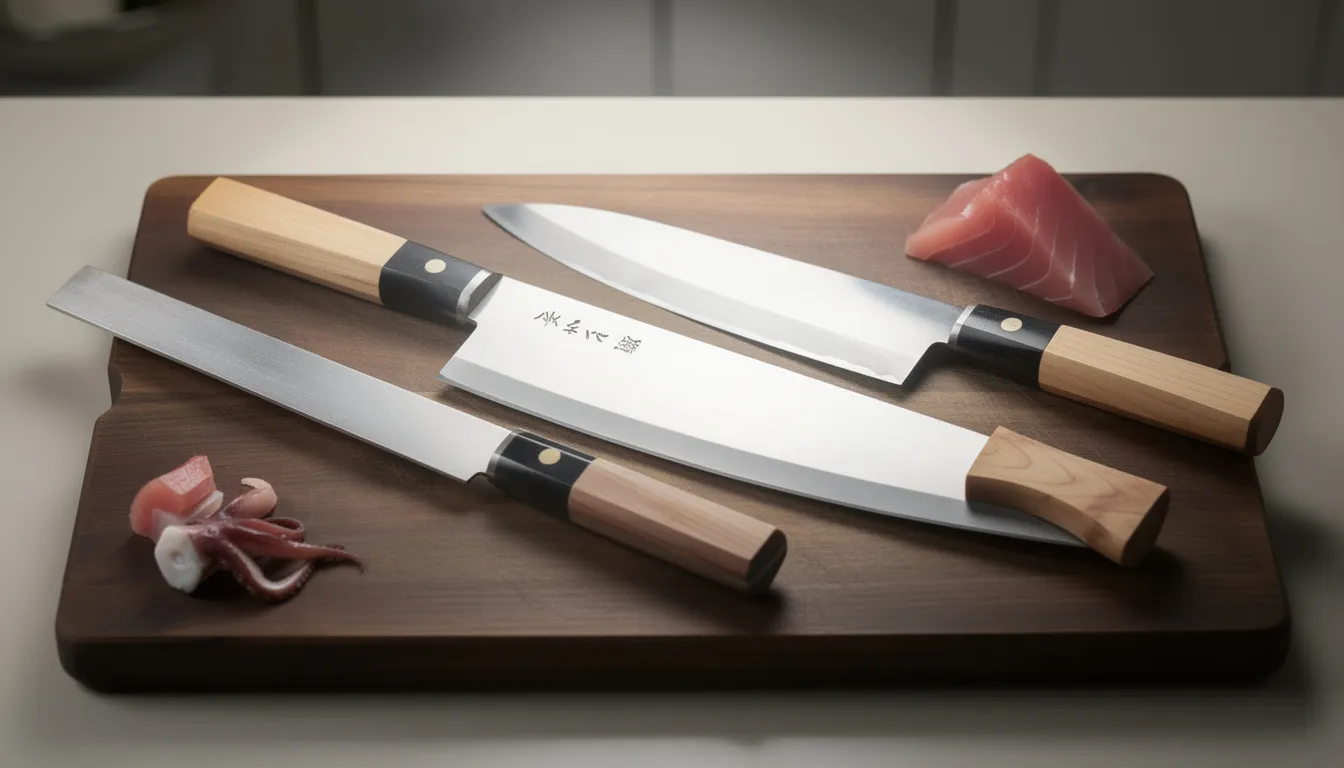
The sakimaru takohiki is a variation of the yanagiba and takohiki, used for much the same purposes. Sakimaru takohiki knives are easily identifiable by their blade tips, which echo a Katana point. The geometry is the whole trick: a straight spine similar to takohiki, paired with a slightly curved edge like yanagiba. That combination changes how the blade tracks through fish—the flat spine keeps the cut line honest, while the subtle curve helps finish a long pull cleanly instead of “parking” at the end.
In practice, this is why sushi chefs keep the sakimaru takohiki close when slicing fish for translucent sashimi. It’s built to glide through delicate fillets, not to bully bones or frozen blocks. On a board, it feels like the knife wants to stay level and just… float forward, as long as you don’t try to twist it mid-cut.
Why does geometry matter here?
Slicing knives reward tiny geometry decisions, then punish sloppy ones. Many sakimaru takohiki are made with a double bevel for broader use and easier maintenance. With a double bevel, it’s simpler to hold consistent angles—think roughly 12–15° per side for general slicing, adjusted to steel and hardness. The trade-off: a classic single bevel has a different food release and a very “guided” feel, but it asks for better stone work and more consistent hands.
From the forge side, grind and thickness often matter as much as steel. A long slicer that’s thin behind the edge will glide through tuna and snapper, but it also hates being torqued mid-cut. The quick reality check most makers give is simple: single bevel vs double bevel, for traditional discipline versus forgiving prep. At MG Forge, that “stop fighting the cut” moment is usually grind-first, steel-second.
Which blade lengths make sense?
For sakimaru takohiki, blade lengths are commonly available in 270mm, 300mm, and 330mm. These blade lengths aren’t decoration—they dictate stance, board space, and whether you can finish the slice in one stroke (or end up doing the sad little saw). A 270mm is easier at home and on smaller boards; 300mm is the common sweet spot at sushi bars; 330mm starts to feel like a dedicated station tool—amazing on long loins, clumsy in tight kitchens.
There’s a sizing rule we repeat in the workshop when someone hesitates: choose the longest blade that can complete your typical cut in one pull, while still leaving a safe margin for the tip and your knuckles. If your station is cramped, dropping from 300mm to 270mm can improve control more than any upgrade in steel ever will.

What steels show up in sakimaru builds?
Sakimaru takohiki knives come in a range of steels and constructions, including Silver Steel #3, Aogami #2, and AUS10 High Carbon Stainless Steel. Silver Steel #3 is known for fine grain and edge retention; that fine grain is the quiet advantage—it takes a crisp edge that bites cleanly into glossy fish skin and keeps that bite through service. Aogami #2 is loved for feel and responsive sharpening, while AUS10 makes sense when a kitchen wants more stain resistance without giving up too much edge character.
In 2026, more buyers ask about the full build, not just the core: cladding, heat treat, and finish. Traditional setups may use soft iron cladding, including fibrous iron, which adds toughness and tells a classic patina story—especially when the core is carbon steel. Pattern-welded options exist too; forge-welded damascus can look wild, but appearance doesn’t replace a good heat treat and patient grinding. MG Forge tends to spend the time where it matters: normalize, harden, temper, then grind until the blade stops arguing with the cut.
How is a sashimi knife used in real prep?
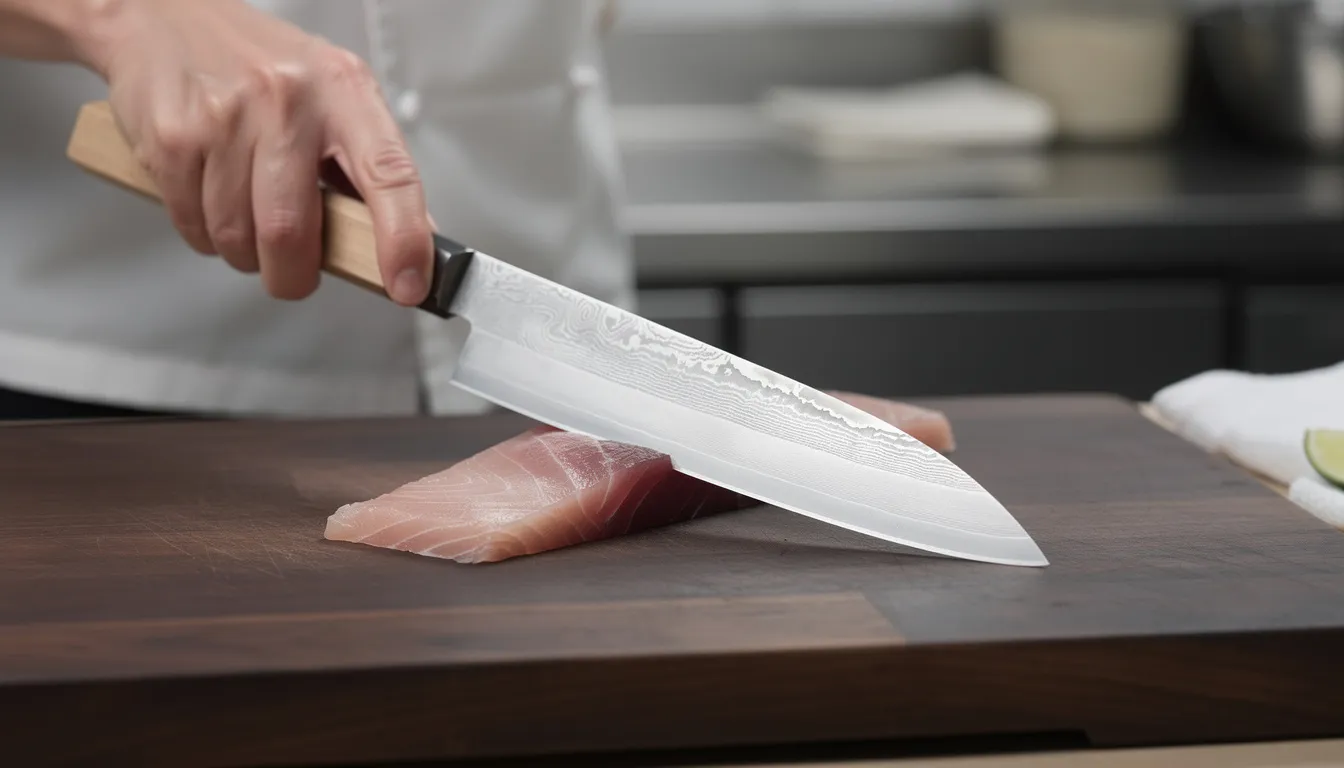
A sakimaru takohiki is crafted for balance and sharpness, and it behaves best when you treat it like a sashimi knife—not like a general-purpose chef’s tool. Technique is the whole game: one long pull cut, minimal downward force, no rocking. With fish, the goal is a single confident pass that leaves a clean surface—less damage, better gloss, better mouthfeel. Even with other delicate ingredients, the same rule holds: long stroke, stable wrist, let the edge do the work.
In many kitchens, sakimaru becomes the “big fish day” blade, while a gyuto (210–240mm) handles most prep, a bunka or kiritsuke steps in for more aggressive veg work, and a petty does close detail cuts. If heavier breakdown is required, a deba shows up—because this isn’t a tuna knife for collars, joints, and bone work. It can portion tuna beautifully, but it’s not meant to chop through hard structure.
What about handles, finishes, and care?
The sakimaru knife often comes with a traditional octagonal Wa handle in woods like ebony or magnolia, which helps you index the blade without looking—handy when service gets loud. Some sakimaru takohiki builds offer custom handle options (Buffalo Horn or Urushi finishes), and those can mean longer waits depending on stock and how the order is fulfilled. These finishes aren’t just “pretty”; they change grip when hands are wet and how the handle ages after hundreds of wipes.
Care is simple, but the rules are not optional: rinse and wipe right away, avoid the sink, and store in a saya, on a magnetic strip, or in an edge-safe guard. High-carbon cores can patina; that’s normal and often welcomed, but rust is a different story. Wash with neutral detergent, dry fully, and apply a tiny bit of oil if the blade will sit—this helps prevent rust. If sharpening is new to you, keep it boring: a medium stone around 1000–2000 grit for maintenance, then refine only if needed; over-polishing can reduce initial bite on slicers.
What is a Sakimaru knife used for?
A Sakimaru is used mainly for precise slicing of fish, especially clean, translucent sashimi cuts. It shines at long, single-stroke pull cuts where surface finish matters. Depending on the grind (single bevel or double bevel), it can handle other fine slicing purposes, but it’s not ideal for bones, frozen food, or heavy chopping.
What factors shape the purchase and care of a sakimaru takohiki for sashimi work?
A sakimaru takohiki is a crafted tuna knife defined by a straight spine and geometry that can vary by size and features, so the purchase often depends on stock, prices, and the ideal blade length for clean pull cuts across delicate ingredients; for checkout, the cart may authorize a payment method and apply shipping charges or vat depending on country, and some listings include dates listed for fulfillment, with bundle options if permitted, while the cancellation policy can cover cancellation, cancel, return, charge timing, and accept rules; although it is not a recurring item, a recurring or deferred purchase or deferred purchase can appear as a frequency setting on a page, and once fulfilled the best ease in use comes from proper care—wipe, store safely, and sharpen moderately—so the blade stays beautiful and long-lasting (add; choose).