Tamahagane steel katana: why it still matters
Why does “tamahagane steel katana” still matter?
The short takeaway is simple: a tamahagane steel katana is as much culture and handwork as it is performance. Tamahagane carries heavy cultural and historical value in Japan, and it’s a symbol of traditional japanese craftsmanship. It’s also widely treated as the best steel for a katana, though “best” depends on what you’re actually doing with the blade. By 2026, buyers don’t just ask “will it cut,” they ask “how was it made, what did it cost in time and material, and what compromises did the smith choose?”
That mindset feels familiar in a kitchen forge. At MG Forge, the same questions show up when someone compares a 210 mm gyuto to a 240 mm, or asks why a bunka feels “snappier” on onions. The craft lives in the choices: steel, heat, geometry, and finish—and yes, expectations.
What makes tamahagane steel different?
Tamahagane is a type of steel made in the Japanese tradition from iron sand. The word tamahagane steel literally translates to “precious steel,” which sets the mood before a hammer even moves. Tamahagane is very pure, since impurities from the iron sand are burned off during the heating process. That purity is part of why collectors chase it—and why it demands real skill at every step of traditional japanese sword making.
The process of making tamahagane involves smelting iron sand and charcoal in a tatara furnace. It’s labor-intensive, run by people who know the rhythm of the fire, and it’s not unusual for the murage mixes to steer the outcome with experience rather than guesswork. Because tamahagane is also one of the most expensive types of steel, not every shop—or every smith—can afford to use it. In practice, that cost reflects time, waste, limited supply in Japan, and the fact that making tamahagane continues as a craft, not a factory setting.
How is a tamahagane blade actually built?
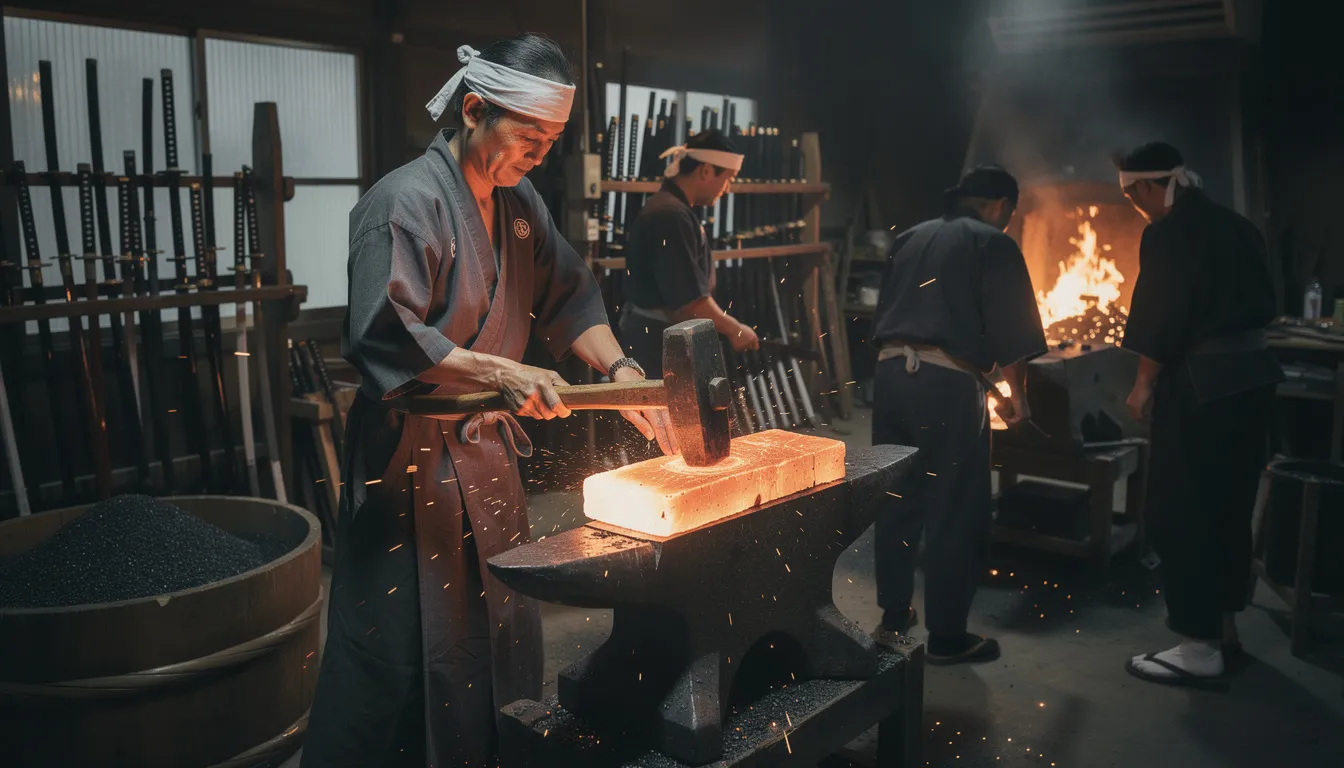
A tamahagane blade isn’t “poured and ground”; it’s built on purpose. Tamahagane is broken into bright silver pieces and darker chunks, sorted by quality and carbon content, then combined through mixing parts to chase the desired result. This is also where “how much metal” matters: you start with more material than you finish with, because selection and losses are part of the process, not a mistake.
Then comes the forge work. Tamahagane undergoes repeated folding and welding, usually 10 to 15 times, to create layers and refine the steel. Each weld is a make-or-break moment: too cold and it delaminates, too hot and carbon burns away. And yes, the billet gets frequently turned, because even heat and clean surfaces decide whether you’re making blades—or making excuses.
Heat treatment is where the drama becomes permanent. Differential hardening with clay creates the hamon, a visible temper line on the blade. The clay tub matters more than people think: the smith applies a clay mixture, and the clay tub measures are part practical, part ritual, part “don’t bump the bench or you’ll regret it.” Done well, it’s not only beauty—it’s a readable record of controlled heating and quenching, aimed at a hard steel edge with more durable behavior behind it.
How does modern steel compare in practice?
Modern steel is made from a range of metals—iron, carbon, and alloying elements—so the recipe is consistent. That consistency is the quiet superpower: it helps hit repeatable hardness and durability without gambling on every step. In practice, swords made from modern steel will be less likely to chip or break than those made from japanese tamahagane, especially when the user treats a katana like a training tool instead of a museum piece.
Modern steels like 1095 carbon steel are often more practical for cutting practice and training. Meanwhile, tamahagane katanas are often more expensive than those made from modern steel due to their unique production process. That trade is clear: modern steel tends to be forgiving, while tamahagane—and a tamahagane katana in particular—tends to be meaningful and demanding. Many japanese swords live somewhere on that spectrum, depending on the maker, the heat treat, and the geometry.

What does sword craft teach kitchen knives?
The overlap isn’t the silhouette; it’s the discipline. Give a knife a thin, hungry edge and it will glide—until it doesn’t. In the shop, a common micro-case is a 180 mm bunka ground very thin for peppers and herbs, then asked to split hard squash; the edge can suffer if the geometry is too aggressive. That’s the same hardness-versus-toughness argument you hear around samurai swords, just with carrots instead of targets.
Practical examples show the pattern:
Yanagiba / sakimaru: single bevel for clean sashimi pulls; a polished bevel is part of the cut.
Gyuto (210/240 mm): double bevel all-rounder; a slightly thicker spine helps food release and confidence.
Deba: thicker grind for fish breakdown; strength lives behind the edge.
Damast skuwany, steel damascus, fibrous iron cladding—these finishes can be art, but geometry decides the feel. A kiritsuke profile can look fierce, yet if the tip is too thin for the user’s board habits, it becomes fragile. That lesson travels cleanly from japanese swords to japanese knives: the edge is only as smart as the steel behind it.
What should be expected from a custom katana in 2026?
Tamahagane steel katanas can be customized according to the buyer's specifications, and that’s a double-edged gift. A custom katana can be tuned for balance, thickness, and handling, but every spec choice shifts the result. Many users report tamahagane katanas as well-balanced and visually appealing, which usually traces back to careful distal taper, controlled shaping, and disciplined polishing rather than luck.
It’s also normal to see mixed feedback at delivery. Some customers have expressed dissatisfaction with the sharpened edge quality of their tamahagane katanas upon arrival. That tracks with knives too (MG Forge sees the same pattern): shipping-safe edges, different standards for “sharp,” and the reality that a final edge is personal. Tamahagane katanas are considered ideal for collectors and enthusiasts of Japanese culture, and many treat them as pieces to maintain rather than tools to abuse.
Care is simple but strict: keep carbon steel clean and dry, avoid soaking, and store with the edge protected. Patina is normal; red rust is not. The routine doesn’t change much whether it’s a tamahagane steel katana on a stand, a tamahagane katana in a collection, or a carbon gyuto on a magnetic strip.
Is tamahagane steel good for swords?
Yes. Tamahagane steel is widely considered the better quality option for traditional japanese sword making and carries major cultural value in Japan. It takes serious craftsmanship because it’s refined by hand, often with 10–15 folds and welds, and the smith has to manage carbon and heat at every step. For hard training use, modern steel is often more durable and less prone to chipping, which is why plenty of japanese swords intended for practice lean that direction.
How much is a tamahagane katana?
Prices vary widely because the process is labor-intensive and tamahagane is among the most expensive steel choices. Tamahagane katanas are often more expensive than swords made from modern steel due to their unique production process. Cost also changes with the level of polish, the maker’s time, and whether it’s a standard katana or a custom katana with specific geometry and fittings.
What is the strongest steel for katanas?
“Strongest” depends on what strength means: toughness against chipping and being broken, or hardness and wear resistance at the edge. Swords made from modern steel will be less likely to chip or break than those made from japanese tamahagane, especially in rough use. If the goal is traditional japanese authenticity—traditional methods, traditional japanese steel, and a construction rooted in history—tamahagane remains the reference point for many tamahagane swords and tamahagane katana builds.
Is it illegal to own a katana in the US?
In most of the US, owning a katana is legal, but rules can vary by state and city. A practical step is to check local blade-length and carry laws, especially for transport and public carry. For home display or collectors, it usually comes down to local regulations rather than a federal ban—whether it’s a katana, other swords, or japanese swords in general.
How do traditional methods shape edge durability in traditional japanese steel like precious steel?
In the article’s framing, traditional methods matter because traditional japanese steel such as precious steel is built by selection, welding, and heat control rather than being treated as liquid, and that hands-on path ties directly to durability at the edge and the cultural history behind it; the word hagane shows up as a shorthand for the steel identity itself, but performance still depends on choices across geometry and heat treatment, not on a magic label, and what some people call lower quality is often a mismatch between expectations, use as tools versus art, or uneven finishing rather than a simple verdict—especially since hard use can leave an edge broken even when the blade is meaningful, and the same discipline carries over in MG Forge’s knife work; over centuries, the point remains that the craft is traditionally demanding and rare, and modern production (including china) changes consistency and outcomes in ways the article contrasts with the older approach (word) (example).