Whetstone sharpening tutorial: angles, burr, grit
What decides sharpness first?
Sharpness is mostly geometry—not magic steel. A typical 210–240 mm gyuto with a thin edge will feel sharper than a thicker grind even at the same stone finish. In practice, most double-bevel Japanese kitchen knives behave well around a 12–15° per side angle, while heavier workhorses (like a deba) usually want a slightly more conservative edge to avoid chipping.
Steel still matters, just in a different way: it changes how the edge behaves on the stone and how long it stays crisp. Hard, fine-grained steels can hold a cleaner apex longer, but they also punish sloppy angle control. In the forge, those tradeoffs show up fast during heat treatment—tiny mistakes there become big annoyances at the whetstone later.
Want to learn how to sharpen your kitchen knives?
A solid whetstone sharpening tutorial shouldn’t read like a cake recipe—it should teach pressure, feedback, and what “right” feels like. The win isn’t a mirror finish; it’s a stable, clean apex that fits the knife’s job. A 240 mm gyuto for onions and proteins can go thinner and keener than a 180 mm bunka that regularly meets hard squash and lots of board contact.
One more thing: single bevel knives (yanagiba, sakimaru) don’t sharpen the same way as double bevel knives (gyuto, petty). Single bevel work is about keeping that wide bevel flat on the stone and managing ura (the back side) cleanup. Double bevel sharpening is easier to start, but it still rewards consistency far more than brute force.
Whetstone Basics?
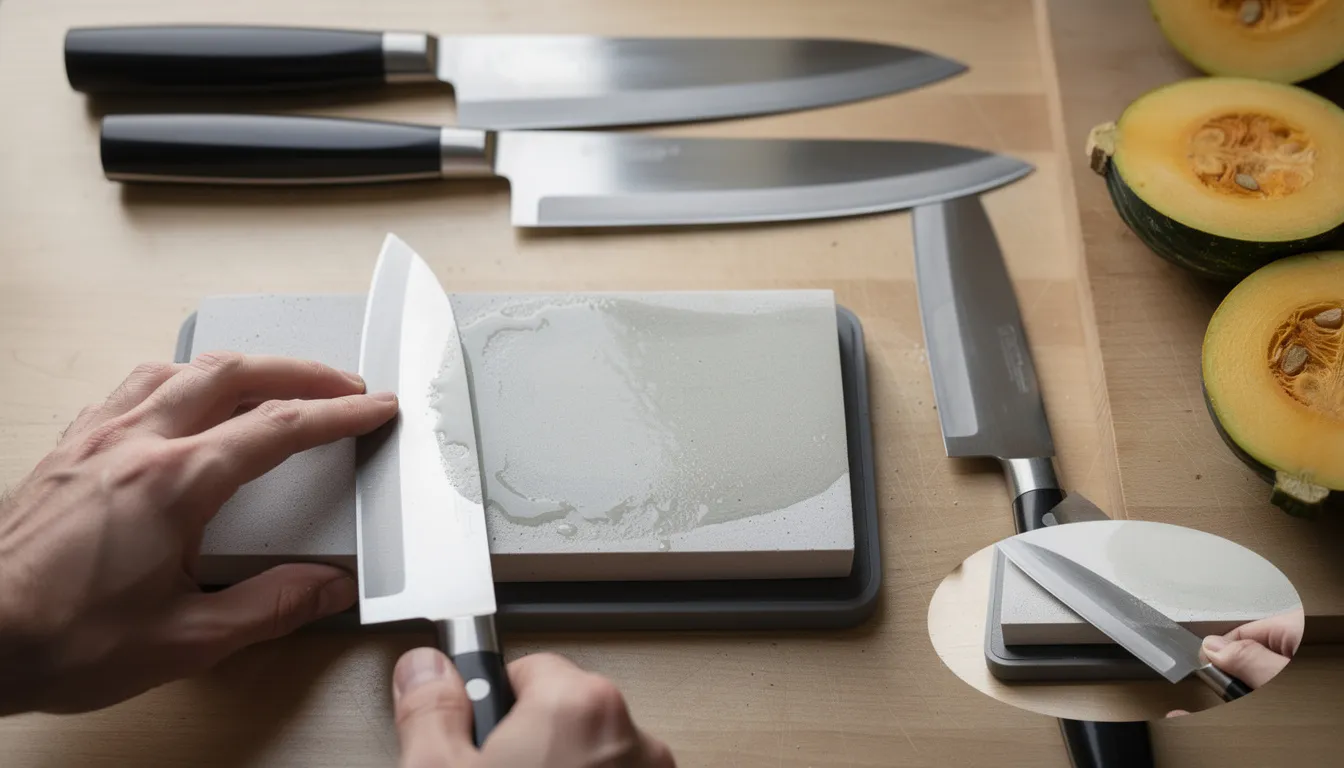
A simple modern setup covers most kitchens: 400–600 grit for repairs, 800–1,200 for everyday sharpening, and 3,000–6,000 for refinement. For most stainless or carbon gyuto and petty knives, 1,000 grit is the daily workhorse. Going finer than 6,000 can feel great, but it often adds polish more than real cutting performance.
Stone choice changes the feedback, too. Softer stones dish faster but give clearer slurry and “talk” to you; harder stones stay flatter but can feel a bit glassy. If a knife is clad in softer iron (common in traditional builds), the stone may remove cladding faster than the core, so the scratch pattern can look uneven even while the edge is improving.

Setting Up?
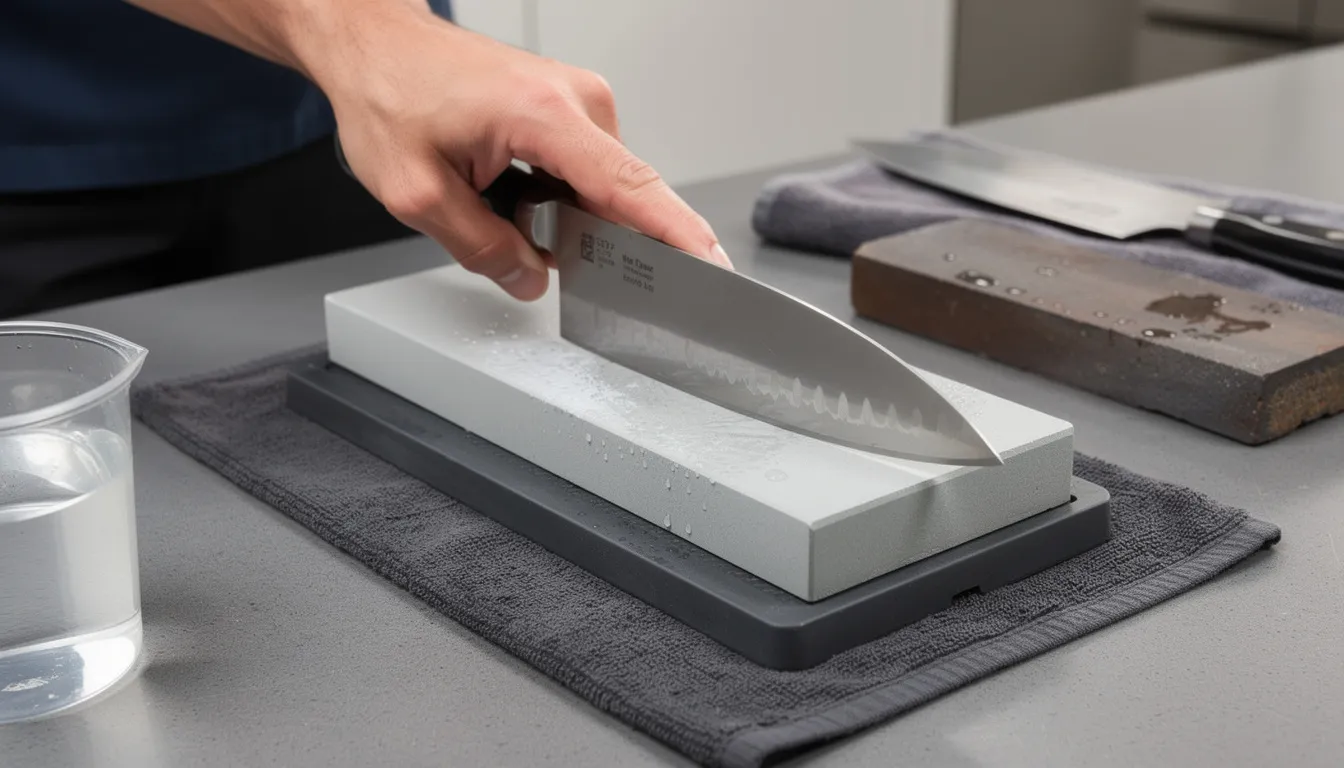
Start with stability: stone on a damp towel or non-slip base, water within reach, and enough light to actually see the scratch pattern. A 210 mm knife needs more travel than most people expect, so a stone around 200–210 mm long simply makes life easier. Keep a flattening plate or coarse stone nearby—flatten every 10–20 minutes so dishing doesn’t quietly round your edge for you.
Angle control is the other half of setup. Locking the wrist and moving from elbow and shoulder helps many cooks keep steady contact. A good reference is 12–15° per side for most gyuto, kiritsuke, and bunka profiles, while a thicker Western-style chef knife often tolerates 15–20° per side without feeling dull.
Beginning To Sharpen?
Pick the stone grit that matches the problem. If the edge is just tired, start at 800–1,200; if there are chips or a rolled section, drop to 400–600 and accept that it takes longer. Use moderate pressure on early strokes, then lighten up as the scratch pattern becomes uniform close to the edge—pressure should taper as you approach “done.”
In the shop, it’s the same rhythm when dialing in an edge after finishing: set the shape first, refine second. MG Forge blades with thin Japanese geometry tend to respond quickly, but that also means the stone doesn’t lie—any wobble in angle shows up as a stubborn dull strip right at the apex.
Forming The Burr?
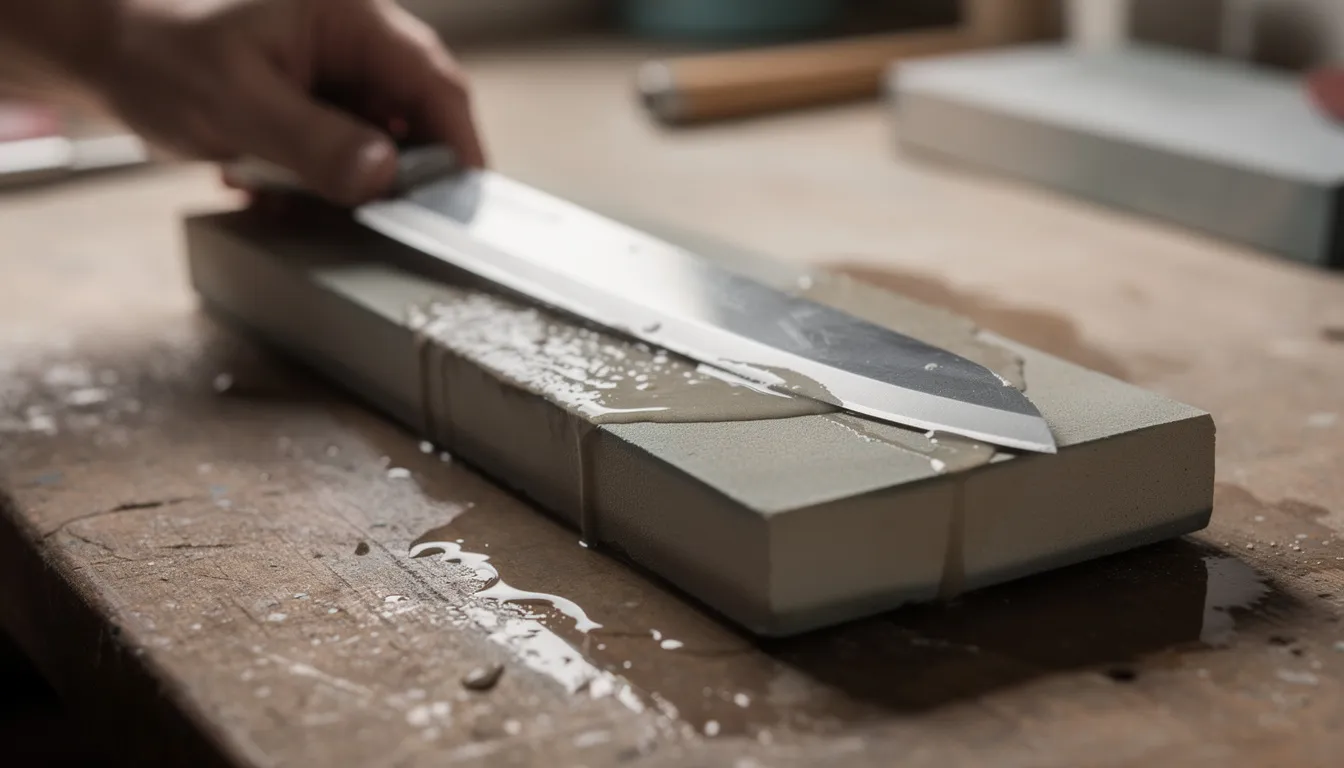
The burr is proof the stone reached the very edge, not an invitation to grind forever. On a 1,000 grit stone, a consistent burr can form in 2–6 minutes per side on a normally worn 210 mm gyuto, but time varies with steel and pressure. Check the whole length—heel, middle, and the last 30–40 mm near the tip are common holdouts.
The usual hitch: if the burr only appears in the middle, your stroke isn’t matching the knife’s belly and tip geometry. A kiritsuke-style profile (flatter) often builds a burr more evenly, while a more curved Western chef knife needs more careful tip work. Keep pressure even and let the stone do the cutting—no arm-wrestling required.
The Other Side?
Once the burr is continuous, switch sides and repeat with slightly lighter pressure. The goal is to move the burr back and forth cleanly, not to grow it bigger like it’s trying to win a contest. Many Japanese knives are ground asymmetrically (even among double bevels), so it’s normal for one side to need fewer strokes.
With single bevel knives like yanagiba and sakimaru, “the other side” is mostly ura cleanup. That usually means very light passes to remove burr and keep the ura flat, not building a second bevel. This is why a yanagiba used for sashimi rewards tidy sharpening—small errors show up as steering in the cut and ragged slices.
Removing The Burr?
Burr removal is where edges are won or lost. After your final sharpening passes, drop pressure to near-zero and do short alternating strokes—5 to 10 per side—holding the angle steady. A few edge-leading strokes can help, but only with light pressure; heavy edge-leading strokes can cause micro-chips on harder edges, which is a real buzzkill.
A practical check: slice paper, then do one gentle pass through soft wood or a cork, and slice paper again. If it cuts better after the wood/cork step, the burr was still hanging on. Clean apex, clean cut—especially obvious on tomatoes and herbs, where a wire edge can feel sharp for 30 seconds and then collapse.
Moving Up In Grit?
Move up only once the edge is already sharp at the current grit. Jumping from 400 straight to 6,000 usually leaves deep scratches and a toothy-but-unstable apex. A sensible progression is 1,000 → 3,000 (or 4,000) → 6,000, with lighter pressure at each step and fewer total strokes—classic whetstone sharpening tutorial logic.
Finer finishes should match real use. A 3,000–4,000 finish on a gyuto often hits a sweet spot for proteins and vegetables, while a yanagiba can benefit from 6,000 for smoother push cuts on fish. The trend in 2026 is clear: function-first finishes over mirror polish, because board feel and bite matter in actual prep.